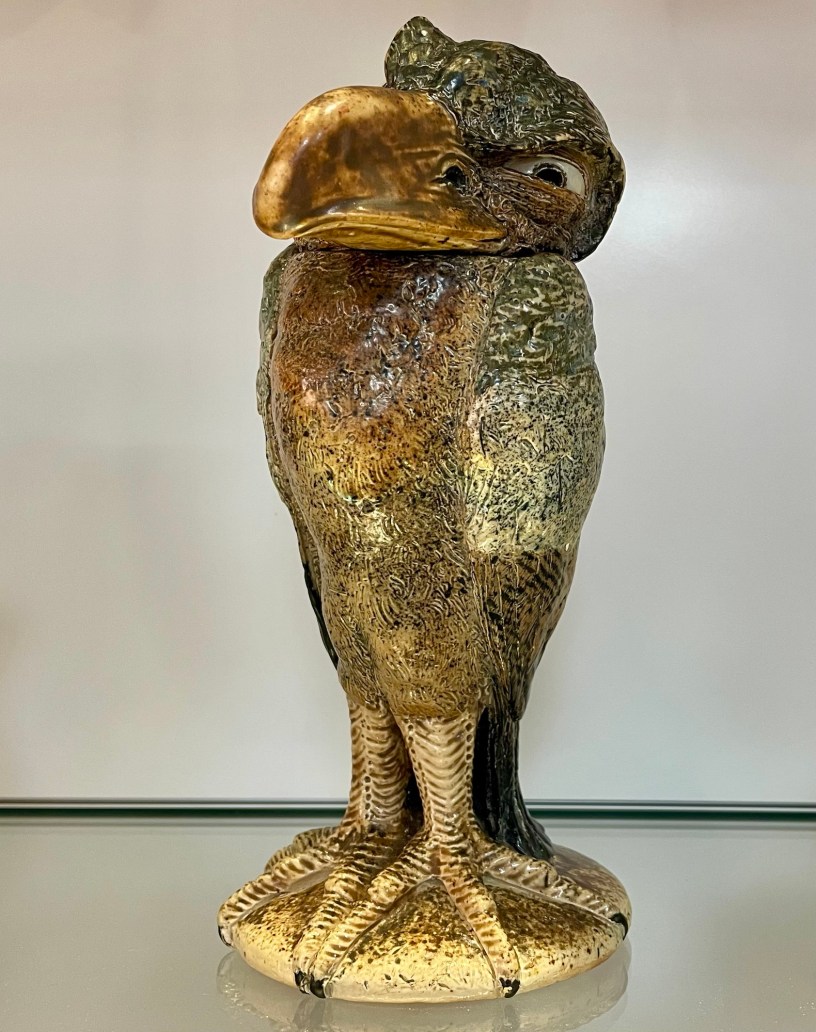
The amazingly weird and wonderful Wally birds might be their most famous but much of the Martin Brother pottery is equally bizarre, and their lives just as memorable.


The business truly was a family affair. Eldest brother Robert Wallace was founder and primary sculptor (and the face in the green pot above!). Walter Fraser was the chemicals guy, creating their distinctive glazes. Edwin Bruce was the decorator, responsible for most of the fish and flower designs. Charles Douglas managed the shop. Sister Alice worked for a time coloring pots, and even Robert Wallace’s son Clement joined.

While the pottery was famous enough to have royal patronage (Queen Victoria and Queen Mary were both fans), it was always a bit of a disaster. The brothers could only afford to run their kiln a few times a year, and due to their firing method and cheap clay, works were often destroyed in the process. One year they produced just a single sellable pot. Of the pieces that successfully emerged from the kiln, Charles would often hide under the shop’s floorboards and refuse to sell. The brothers made laborer’s wages and burned furniture to fire the kilns. In 1903 a fire destroyed their showroom, taking two years of work with it.
Charles was blamed for the fire, and apparently tried to throw himself out a window. Later diagnosed with mental illness, he died in an asylum. Their sister died from a monkey bite. Edwin of facial cancer. Walter knocked his elbow while packing the kiln, resulting in a fatal cerebral hemorrhage, which, because he never recorded recipes, meant the pottery’s range of colored glazes were never fully replicated. Oldest brother Robert Wallace was the only one to live into old age, and was the only one to see the beginning of their pottery’s financial success.

From 1877 until its closure in 1915 the pottery ran out of an old factory in Southall. Its location along the Grand Union canal inspired the brothers, with designs incorporating the birds, insects, and flora found along the waterway. Walter created new glazes to match in rustic shades of blue, brown, green and yellow, colors which came to define the studio’s distinctive palette.

The factory is long gone, but a room in Southall’s Dominion Centre library is devoted to the pottery. It’s a great place to start exploring.

There is also a walking tour of town (https://ealingculture.org/wp-content/uploads/2024/05/MW_Map_2023_Final_Printversion_17.10.pdf) which visits: the canal, brother’s homes, final resting spot, and the Tudor Southall Manor in whose garden this amazing Martinware fountain lived until it was sadly destroyed by fire in 1988.


Contrary to the brothers’ time, Martinware now commands seriously high prices, especially the Wally Birds and other grotesques. Pieces can be found in museums worldwide, including these examples from the V&A, Delaware Art Museum and Metropolitan Museum of Art.


